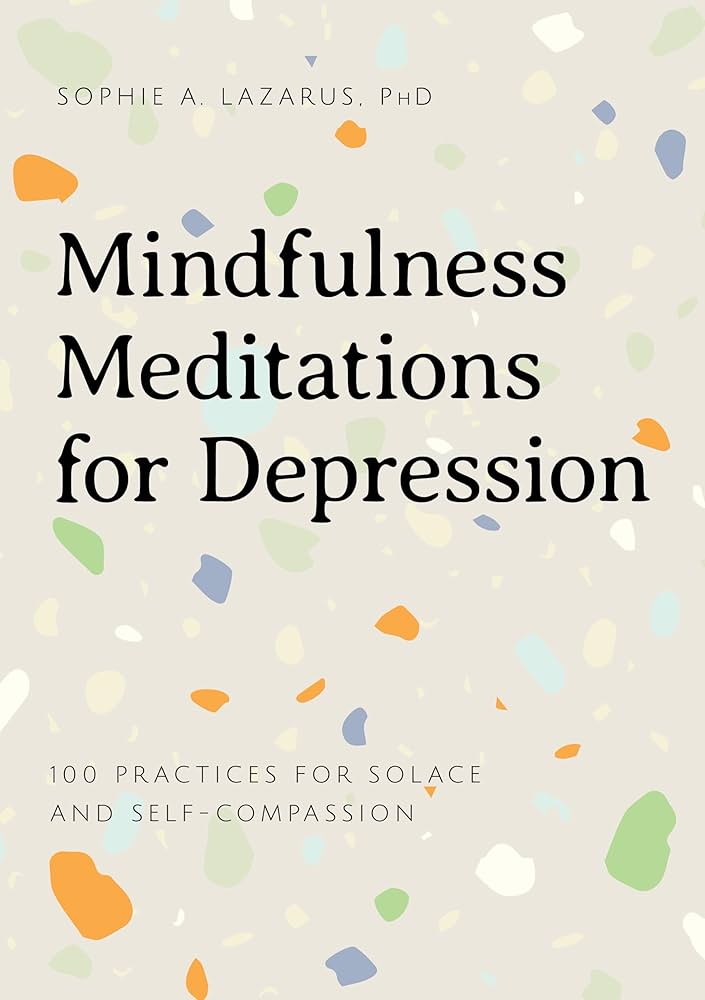
Mindfulness Meditation for Depression
By Sophie Lazarus
A psychoanalytic reading of Mindfulness Meditations for Depression by Sophie A. Lazarus situates the text within a contemporary therapeutic paradigm that privileges awareness, regulation, and self-compassion over interpretation and unconscious conflict.
- Depression as Presence vs. Depression as Meaning
The book frames depression as a condition to be met with:
- non-judgmental awareness
- acceptance of internal states
From a psychoanalytic standpoint, this represents a decisive shift:
- depression is treated as an experience to be observed
- rather than a structure to be deciphered
In Freudian terms, depression (melancholia) involves:
- identification with a lost object
- aggression turned inward
Mindfulness, as presented here, suspends the question of why and focuses on how it feels.
- The Suspension of Interpretation
Mindfulness practice encourages:
- observing thoughts without attachment
- letting them pass without elaboration
This directly contrasts with psychoanalytic technique, which:
- privileges free association
- seeks meaning in even the smallest psychic formations
From a Lacanian perspective, mindfulness risks:
- flattening the signifying chain
- neutralizing the subject’s relation to language
Thoughts become events, not signifiers.
- The Ego and Self-Compassion
A central axis of the book is self-compassion:
- treating oneself with kindness
- reducing harsh self-criticism
This is clinically valuable, especially in depressive states marked by:
- superego severity
- internal punitive voices
Here, psychoanalysis and mindfulness partially converge:
- both recognize the destructive role of the superego
However:
- mindfulness aims to soften and regulate the superego
- psychoanalysis aims to interpret and reconfigure its origins
- Affect Regulation vs. Psychic Conflict
The exercises in the book function as tools for:
- regulating affect
- grounding the subject in the present
From a psychoanalytic perspective, this may have a dual reading:
- positively: it provides containment and reduces overwhelming affect
- critically: it may act as a defensive bypass of deeper conflict
The depressive subject is helped to:
- feel better
but not necessarily to: - understand the unconscious determinants of suffering
- Time Without History
Mindfulness is radically oriented toward the present moment.
Depression, instead, is deeply tied to:
- past losses
- unresolved identifications
- unconscious memory traces
By privileging the present, the book:
- reduces rumination (therapeutically effective)
- but also suspends the historical dimension of the psyche
In psychoanalytic terms, it risks removing:
- the temporal depth where meaning emerges
Final Assessment
From a psychoanalytic perspective, the book is:
- clinically useful, especially for managing depressive affect and softening superego aggression
- structurally limited, as it brackets the unconscious, history, and symbolic meaning
It transforms depression from:
- a conflict-laden psychic structure
into - an experiential state to be observed and regulated
In doing so, it offers relief and stability, but not interpretation.
Psychoanalysis would consider it a valuable adjunct, not a substitute—effective in containing suffering, yet silent on its deeper origins.