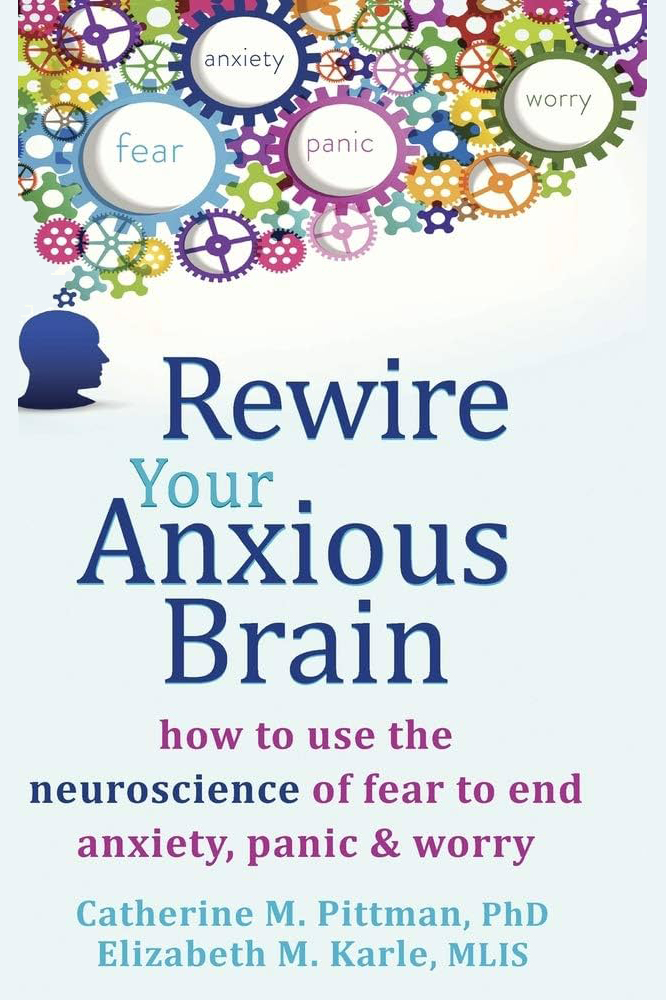
How to Rewire Your Anxious Brain
By Catherine Pittman
- Anxiety Without the Unconscious
The book frames anxiety as the product of two neural systems:
- the amygdala (automatic, emotional fear)
- the cortex (cognitive worry)
From a psychoanalytic perspective, this is a radical reduction:
- anxiety is treated as neurophysiological dysregulation
- rather than a signal of unconscious conflict (Freud’s Signalangst)
What is absent is the idea that anxiety means something—that it is:
- a compromise formation
- a manifestation of repressed desire or conflict
Instead, anxiety becomes something to manage, not interpret.
- From Symptom to Mechanism
In psychoanalysis, symptoms are symbolic formations:
- they encode unconscious material
- they require interpretation to be resolved
In this book, symptoms are:
- maladaptive neural patterns
- to be “rewired” through behavioral and cognitive intervention
This shift reflects a broader theoretical divide:
- psychoanalysis → symptom as message
- neuroscience-CBT model → symptom as malfunction
The consequence is that the subject’s inner narrative is largely bypassed.
- The Body and the Drive
Where the book is unexpectedly close to psychoanalysis is in its emphasis on:
- automatic bodily responses
- non-conscious activation (amygdala-driven fear)
This resonates—indirectly—with:
- Freud’s concept of drive (Trieb)
- and later theories of affect preceding cognition
However, the difference is crucial:
- for psychoanalysis, the body is erogenous, symbolic, and historical
- here, it is biological and ahistorical
There is no exploration of how anxiety might be tied to:
- early relational experiences
- internalized objects
- unconscious fantasies
- Control vs. Meaning
The therapeutic aim of the book is clear:
- gain control over anxiety
- reduce symptoms through practical strategies
From a psychoanalytic viewpoint, this raises a structural tension:
- control may function as a defense against unconscious material
- symptom reduction may leave underlying conflict intact
In Lacanian terms:
- the book operates entirely within the Imaginary and biological Real
- bypassing the Symbolic dimension where meaning is produced
- Repetition Without History
The book acknowledges repetitive anxiety patterns, but explains them as:
- conditioned neural pathways
- reinforced through habit
Psychoanalysis would instead read repetition as:
- return of the repressed
- or repetition compulsion tied to unresolved psychic conflict
What is missing is temporality:
- no past
- no developmental narrative
- no unconscious memory
Final Assessment
From a psychoanalytic perspective, the book is:
- highly effective at the level of symptom management
- theoretically reductive, eliminating subjectivity, history, and unconscious meaning
It transforms anxiety from:
- a psychic signal to be interpreted
into - a neural circuit to be retrained
In doing so, it offers clarity and practical utility, but at the cost of depth.
A psychoanalytic approach would not reject its methods outright, but would see them as:
- addressing the surface organization of anxiety
- while leaving its unconscious determinants structurally intact